Request a quoteInquire

Materials and construction

Puffer jacket vs down jacket: a buyer's guide to insulation

A plain-language guide to jacket insulation for buyers: how a puffer differs from a down jacket, how down compares with synthetic fills, how quilting and shell fabric affect warmth, and how to judge a jacket before ordering stock.

  • 38+years in business
  • 42-78size range
  • Gerberautomated cutting
Puffer jacket vs down jacket: a buyer's guide to insulation

In the puffer jacket vs down jacket question, the two terms describe different things: puffer refers to the construction, a quilted jacket with puffed sections, while down refers to the fill. A puffer can be filled with down, a down blend or synthetic fibres. ADONIS (Adonis Factory) is an outerwear manufacturer in Kharkiv, Ukraine, founded in 1988; since 2002 it has made women's puffer, winter and transitional jackets, with its own decorative and technical quilting workshop.

This guide is for store buyers, marketplace sellers and brands who need to explain the difference between styles to their customers and order the right stock. It describes general material properties as used across the market. For the composition and fill of a specific ADONIS style, ask a manager when you select the range.

A jacket's warmth depends on more than its fill. The amount of insulation, the quilting method, the density of the shell fabric, the length of the garment and details such as the hood, cuffs and the storm flap behind the zip all matter as much.

01

Puffer jacket vs down jacket: what is the difference?

A down jacket is defined by its fill, natural down and feathers, while a puffer is defined by its look: horizontal or patterned quilted sections that puff up around the insulation. Many puffers are synthetic, and some down jackets are not quilted in the classic puffer way, for example long down coats with wide channels. A padded jacket usually means a synthetic-filled jacket, often flatter than a puffer. A winter jacket is the broadest term and also covers parkas and insulated coats. For buyers, the label to read is the fill composition, not the style name.

  • Down jacket: named for the fill
  • Puffer: named for the quilted construction
  • Padded jacket: usually synthetic and flatter
  • Winter jacket: the broad category
  • Read the fill composition, not the style name
02

Down vs synthetic: which insulation is warmest?

Weight for weight, natural down is the warmest fill, because its clusters trap more still air. Down quality is described by the down-to-feather ratio, where more down means a lighter, warmer fill, and by fill power, a measure of loft. Its weak points: down clumps when wet for long periods, needs a down-proof fabric so clusters do not escape, and requires gentle washing and thorough drying. Synthetic fills cost less, wash easily and raise no questions about raw material origin, although traditional bonded wadding flattens over time. Down and synthetic blends sit between the two and combine part of the advantages of each.

  • Down: most warmth per gram, more demanding care
  • Down-to-feather ratio on the label
  • Fill power as a measure of loft
  • Synthetics: lower cost, simple care
  • Blends as a middle ground
03

What insulation is used in puffer jackets?

Puffer jackets on the market use either down and feather, down blends, or one of several synthetic fills. Traditional polyester wadding, known in Eastern Europe as sintepon, is a thin sheet of fibres bonded by heat or adhesive: affordable and common in light transitional jackets and vests. Hollow fibre, made of hollow siliconised polyester, is springier, recovers its loft faster and keeps its shape through washing, which is why it is widely used in winter jackets. Fine microfibres, including the Thinsulate brand, insulate in a thin layer and allow a slimmer silhouette. Synthetic down alternatives use clusters of microfibre to mimic the softness of natural down.

  • Polyester wadding: thin and affordable
  • Hollow fibre: springy, holds its shape
  • Microfibre: warmth in a thin layer
  • Synthetic down alternatives: soft, down-like feel
  • Grams per square metre are not comparable across fibres
04

Quilting and construction: where warmth is gained or lost

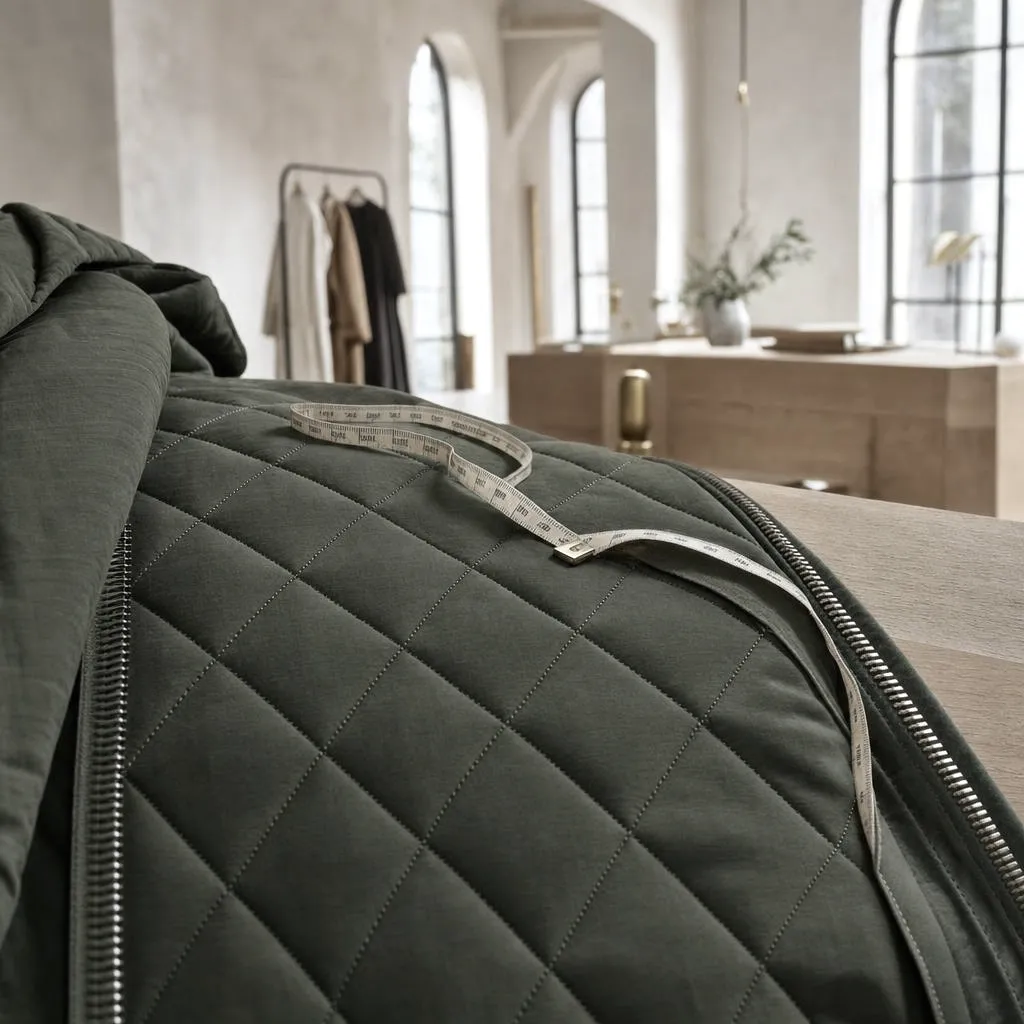
Quilting holds the insulation in place, and its type decides how much heat escapes along the seams. The most common method, stitch-through quilting, sews shell, fill and lining together: it is simple and gives the familiar puffer relief, but the layer is thinnest along each stitch line. Small cells keep the fill evenly spread, large cells give more loft but let the fill shift more easily. Synthetic wadding is often supplied as ready quilted fabric, used for vests and transitional jackets. The quilting pattern, whether diamond, wave or horizontal channels, is also a design element; at ADONIS decorative and technical quilting is done in-house to the factory's own patterns.

  • Stitch-through: simple, thinner at stitch lines
  • Small cells: even distribution
  • Large cells: more loft
  • Quilted fabric for vests and transitional styles
  • Quilting pattern as part of the design
05

How to judge warmth before you buy

Before ordering, assess a jacket as a system rather than by one word on the swing tag. Ask the supplier for the specification: shell, lining and fill composition, the amount of insulation and the intended season. On the sample, squeeze a section and release it: good fill recovers its loft quickly. Check that the insulation is even across the garment, especially at the shoulders and sleeves. The shell should be dense and windproof; membrane fabrics add water protection while letting vapour escape. Look at the details: hood, cuffs, an inner storm flap and the length of the garment all change how warm it feels. Temperature ratings on labels are indicative, as there is no single standard for city jackets.

  • Specification: shell, lining and fill
  • Amount of insulation and intended season
  • Squeeze test on the sample
  • Even fill at shoulders and sleeves
  • Windproof shell or membrane
  • Hood, cuffs, storm flap

FAQ

What wholesale buyers ask

What is the difference between a down jacket and a puffer jacket?

A down jacket is named for its fill, natural down and feathers, while a puffer is named for its quilted, puffed construction. A puffer can contain down, a down blend or synthetic insulation, so not every puffer is a down jacket. To know what you are buying or selling, check the fill composition on the label or specification.

Which insulation is warmest for a winter jacket?

Weight for weight, natural down is the warmest, which is why down jackets feel light for their warmth. Modern synthetic fills such as hollow fibre or microfibre come close in everyday city use and cope better with damp. In practice, the amount of fill, even quilting and a windproof shell matter as much as the fill type.

What is a padded jacket?

A padded jacket is an insulated jacket filled with synthetic wadding rather than down, usually flatter and less voluminous than a classic puffer. It is easy to care for, holds its shape in wet weather and is often lighter on the budget. Padded styles are common for transitional seasons and for customers who prefer a slimmer look.

Is a down coat better than a synthetic puffer coat?

Neither is better in every case. Down gives more warmth for less weight and packs down small, while a synthetic puffer coat is easier to wash, cheaper and more forgiving in wet weather. For a dry, cold climate and customers who value lightness, down works well; for frequent thaws and rain, synthetics are more practical.

What is a membrane fabric?

A membrane fabric has a thin film laminated or coated onto the textile that blocks wind and water while letting water vapour from the body escape. It is described by its waterproof and breathability ratings. City jackets more often use dense fabrics with a water-repellent finish, while membranes are most useful in active and rainwear.

Which insulation does ADONIS use?

The insulation is chosen for each style and season, so it differs between puffer, winter and transitional jackets. An ADONIS manager gives the shell, lining and fill composition of a specific style when you select the range. For private label, the insulation is agreed with the client during development and fixed in the approved sample.

Quote request

Choosing warm styles for the season?

Tell us the climate and customer you are buying jackets for. An ADONIS manager will send styles with material composition and wholesale terms.

+38 099 222 55 29

What do you need made?

Describe the style, quantity and timing in your own words. Our wholesale sales manager will cost the order and send you a quote.

Wholesale clients only. We reply during business hours.